Guided implant surgery · Taepyeong, Seongnam

Guided (Navigation) Implant Surgery near Taepyeong Station, Seongnam

Guided or navigation surgery means your implant position is planned on a computer from 3D scan data and then carried out with a guide.

No separate lineGuided surgery on the published list
₩350K+MegaGen implant + PFM crown
3DImaging used for planning
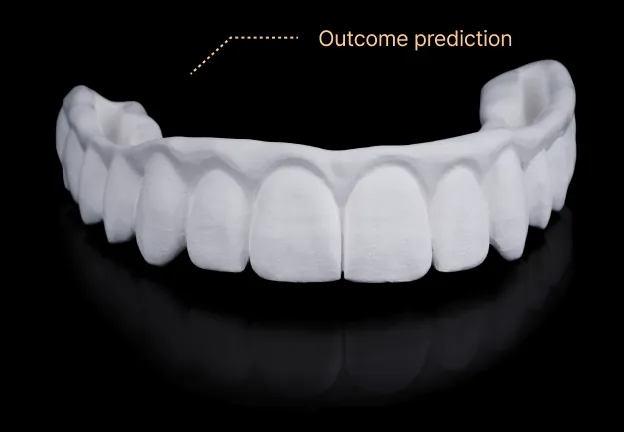
Diagnostic wax-up used to preview a full-arch result

Ask about Guided Implant Surgery

Tap what fits — your message is prepared for you. Nothing is sent until you press send.

Send opens your email app addressed to theseouldc@naver.com. Prefer chat? KakaoTalk channel · Instagram DM · or call +82-31-757-1525.

The short answer

Guided or navigation surgery means your implant position is planned on a computer from 3D scan data and then carried out with a guide. The clinic's published schedule does not list a separate guided-surgery fee; ask whether it is planned for your case and how it appears on your written quote. It gives your dentist more information before surgery, but it does not replace clinical judgment or promise a particular result.

How Navigation Implant Surgery Works

In conventional placement, a dentist relies on X-rays and experience to decide where the implant goes. Guided surgery adds a digital step: the plan is built on screen first, and a guide or navigation system helps carry that plan into the mouth.

The approach depends on good imaging. A 3D scan shows the shape and height of the jawbone, the position of nerves and, in the upper jaw, the sinus. Your dentist uses that picture to choose where the implant sits and how deep and steep it should be.

The published price list has no separate line for guided surgery. Ask your dentist whether it is planned for your case, and check how it appears on your written quote.

3D scan

Your dentist captures 3D imaging of the jaw. A CT fee is not published, so ask about it when you book.

Computer plan

Position, direction and depth are planned on screen, and you can ask to see the plan explained.

Guide or navigation

A guide or navigation system helps place the implant as planned, under local anesthesia.

Check and healing

Your dentist verifies placement and explains healing, cleaning and follow-up.

Video slot · guided-implant-surgery-taepyeong-seongnam-video

Guided Implant Surgery for Taepyeong, Moran, Sujin and Bundang Residents

The clinic is by Taepyeong Station, Exit 5, in Sujin-dong, Sujeong-gu, Seongnam. Residents of Taepyeong, Moran, Sujin, Sinheung, Gachon and the Wirye New Town area can reach a dentist who plans implants digitally without making every appointment a trip into central Seoul.

Guided cases tend to have a clear sequence: planning visit, surgery, healing check and crown. Being able to return to a nearby clinic for the shorter check-ups is a practical advantage for working parents, students at Gachon University and shift workers.

Moran and Sujin are on the Line 8 side of the local map, and Moran and Bokjeong also appear on the Suin-Bundang Line, so many Bundang-side residents can plan a route by subway. We do not quote travel times; check your own route in a map app before booking.

The clinic is open Mon–Wed 09:30–20:30, Thu 09:30–19:00, Fri 09:30–18:30 and Sat 09:30–13:00, with no lunch break; it is closed on Sundays and open on public holidays. Ask in English if you would like the plan explained step by step.

Benefits: Precision and Recovery

The main benefit of planning on a computer is foresight. Your dentist knows in advance how much bone is available and where nearby structures sit, so there are fewer unknowns on the day.

Planning can also help with the crown. If the final tooth position is considered at the planning stage, the implant can be placed with the finished result in mind, rather than only where the bone is.

Some patients find that a well-planned procedure feels more straightforward, because the steps are known beforehand. Recovery still varies. Swelling, tenderness and a need to eat soft food for a while are common after any implant surgery, and your dentist will give instructions that fit your case.

No guide can guarantee how your body heals. Gum health, smoking, diabetes control and cleaning habits all affect the outcome, and these are discussed at your examination.

  • More information about bone and nerves before surgery
  • Implant position chosen with the crown in mind
  • A clear plan you can ask your dentist to explain
  • No separate guided-surgery line on the published list; confirm on your quote

Who Is a Good Candidate

Many adults with a missing tooth or several missing teeth can be assessed for guided placement. Suitability is decided after examination and imaging, not from a questionnaire.

Factors your dentist considers include the amount and quality of bone, the health of the gums, your general health and medicines, and whether you smoke. Some people need gum treatment or a bone graft first, and some are better suited to a different solution such as a bridge or denture.

If you have little bone in the upper back jaw, a sinus lift may be discussed; it is quoted after CT examination. If the ridge is thin, a bone graft (listed at ₩100K to ₩1M by extent) may be suggested. Both are decided after imaging.

Tell your dentist about heart conditions, blood-thinning medicines, bisphosphonates, pregnancy or any recent illness. These do not automatically rule out an implant, but they change how it is planned.

What to Expect on the Day

On the day of surgery, your dentist reviews the plan with you, confirms your medical history and makes sure you understand the steps. Local anesthesia is used, and conscious sedation is available at ₩300,000 (general) or ₩400,000 (with an anesthesiologist) if you prefer.

The implant is placed using the guide, and your dentist checks the position before closing. You then receive written aftercare instructions covering eating, cleaning, medication and what to watch for.

Eat beforehand unless you have been told otherwise, wear comfortable clothing and arrange a ride home if you are having sedation. Do not plan strenuous exercise that evening.

Contact the clinic at +82-31-757-1525 if bleeding, swelling or pain seems to be getting worse rather than better.

  • Bring your medication list and any X-rays
  • Ask whether you should eat before sedation
  • Arrange a quiet rest of the day
  • Keep the written aftercare sheet nearby

Guided and Freehand Placement Compared

Both approaches depend on the skill of the dentist. The table explains the general difference and is not a ranking of outcomes.

PointGuided or navigationFreehand
PlanningPosition planned on a computer from 3D dataBased on X-rays and the dentist's judgment
Information before surgeryDetailed view of bone and nearby structuresDepends on the imaging taken
Fee at this clinicNo separate line on the published list; confirm on your quoteNot a separate line on the published list
Where it helps mostCases where position matters for the crown or nearby structuresSimple, well-defined cases
Who decidesYour dentist, after examinationYour dentist, after examination

Questions to Ask Before Surgery

Use the consultation to understand your own plan rather than the technology in general. These questions help.

If any answer is unclear, ask again in plain terms. You are entitled to understand your plan before you agree to it.

  • Is guided surgery suitable for my case, and why?
  • Will a graft or sinus lift be needed first?
  • Which implant brand and crown are planned, and what do they cost?
  • What is the healing period before the crown?
  • What should I do if something feels wrong after the surgery?
Clinical case

A case from the clinic

Full-arch implants

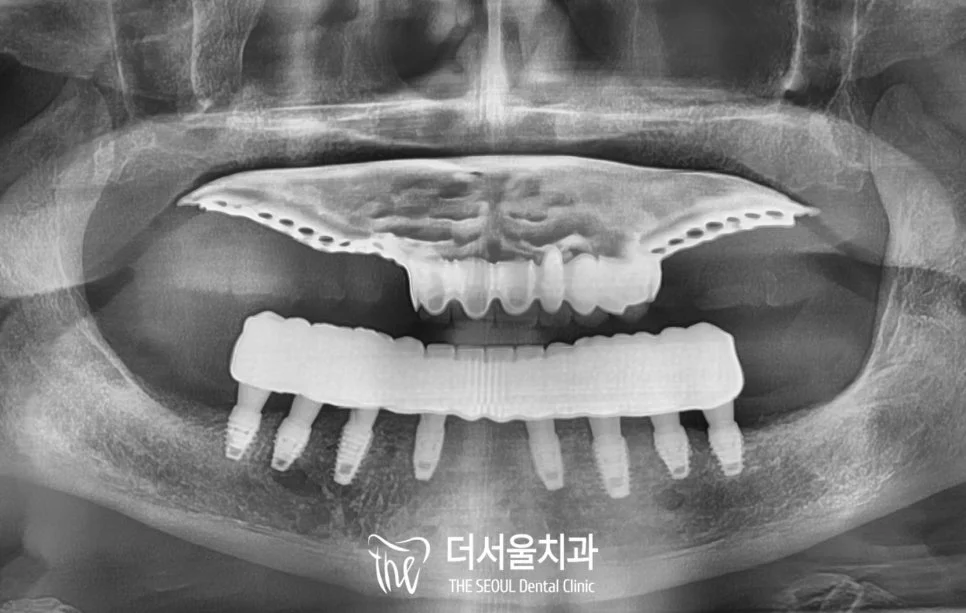
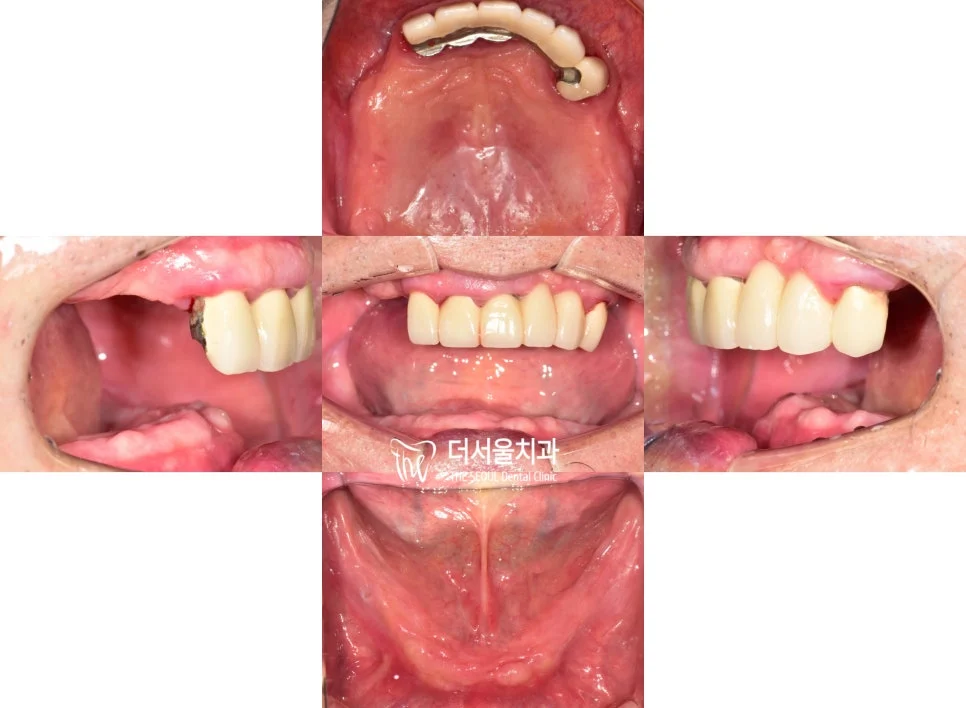
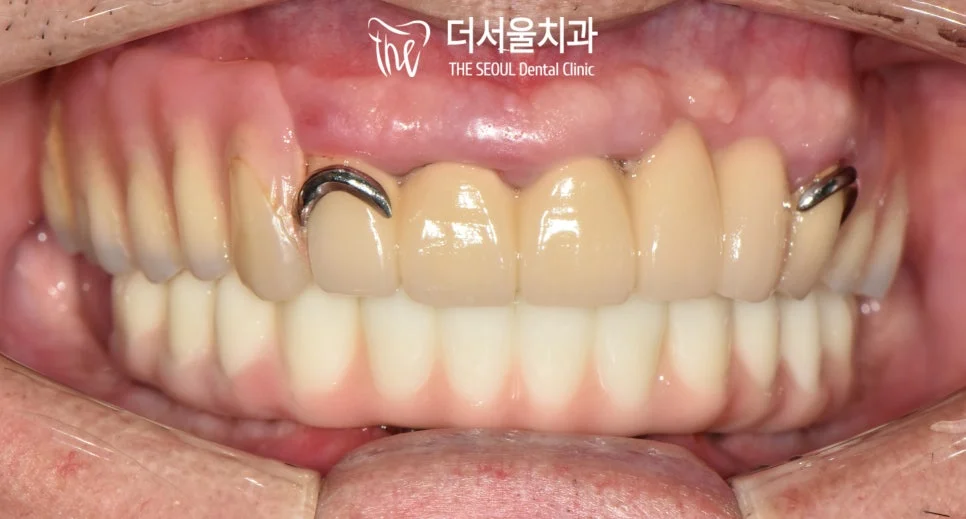
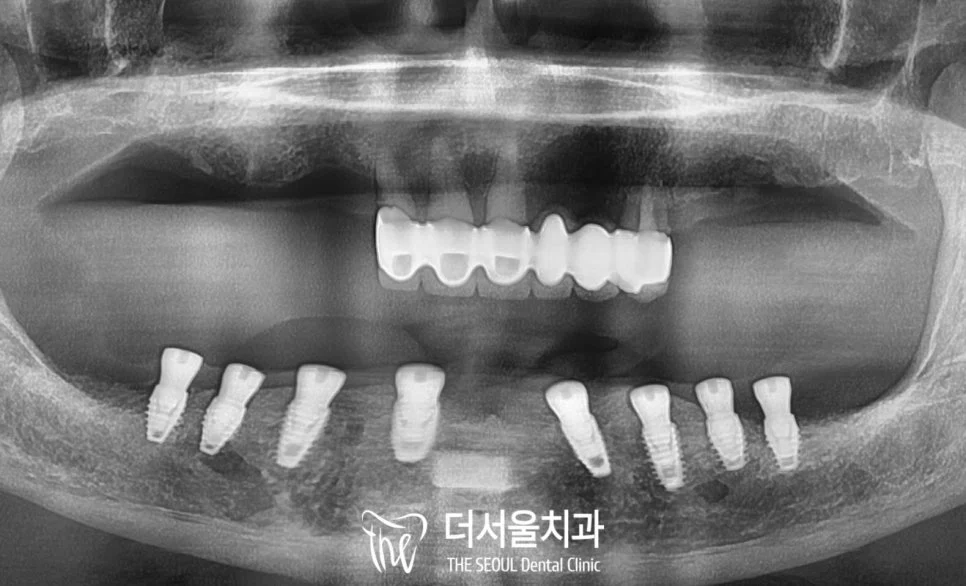
Full-arch implants after years of a loose lower denture

Treated by Dr. Hyeonjoon Park

BeforeBefore: Full-arch implants after years of a loose lower denture
AfterAfter: Full-arch implants after years of a loose lower denture
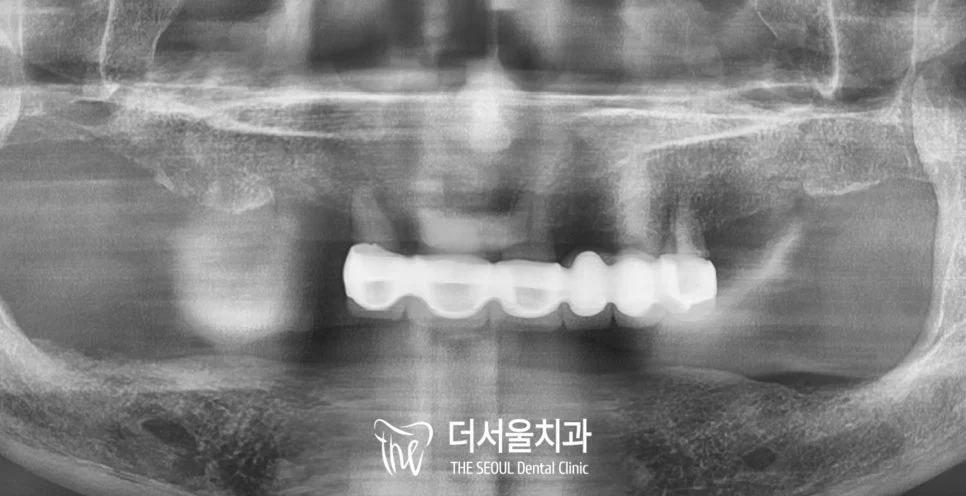
Panoramic X-rays before and after treatment
BeforeBefore: Full-arch implants after years of a loose lower denture
AfterAfter: Full-arch implants after years of a loose lower denture
Intraoral photos before and after treatment

Why the patient came in

The patient had worn a lower denture for many years. It moved while eating and had to be removed and cleaned after every meal. The panoramic X-ray showed that long-term denture wear had left the lower jawbone low and thin.

What was done

  1. 3D CT and an intraoral scan were used to plan implant positions, angles and lengths on the computer before surgery.
  2. Eight implants were placed in the lower jaw, together with a bone graft.
  3. Fixed temporary teeth were connected to the implants the day after surgery.
  4. About three months later, custom abutments and the final full-arch prosthesis were fitted.
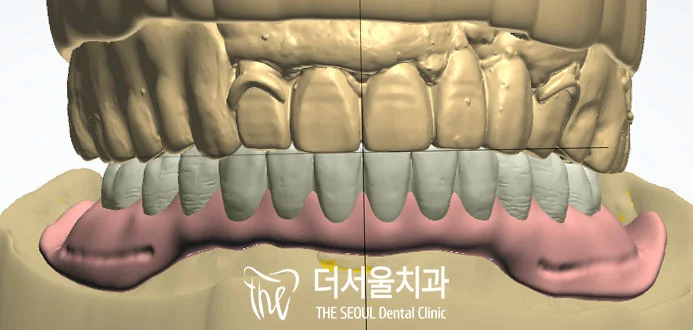
Digital design of the prosthesis from the scan data
X-ray after implant placement with temporary teeth

Published with the patient’s consent. Photos and X-rays are from the clinic’s records. Treatment plans and results differ for every patient; only an examination can show what is possible for you. Implant surgery can cause swelling, bruising or discomfort for some days, and implants need regular check-ups and careful cleaning to avoid peri-implantitis.


See more before and after cases →

Your dentists

English-speaking dentists in Seongnam

The clinic was founded by two brothers trained at Seoul National University who direct it together. Three further dentists hold Ministry of Health and Welfare specialist certifications. Full credentials →

Dr. Hyun Sung Park, Clinic Director at The Seoul Dental Clinic

Dr. Hyun Sung Park

Clinic Director

  • Co-founder and joint clinic director
  • DDS, Seoul National University School of Dentistry
  • Master’s degree, SNU Graduate School of Dentistry
  • Former staff, Dept. of General Dentistry, SNU Dental Hospital
  • Microendodontics Programme, SNU
  • Course completion, UCLA, USA
  • Member, UPenn Endodontics Study Club, USA
  • Certified Invisalign Provider
  • Osstem Implant AIC Programme
  • Member, International Congress of Oral Implantologists (ICOI)
Dr. Hyeonjoon Park, Clinic Director at The Seoul Dental Clinic

Dr. Hyeonjoon Park

Clinic Director

  • Co-founder and joint clinic director
  • DDS, Seoul National University School of Dentistry
  • Master’s degree, SNU Graduate School of Dentistry
  • Former staff, Dept. of General Dentistry, SNU Dental Hospital
  • Affiliate Associate Fellow, American Academy of Implant Dentistry (AAID)
  • Certified Invisalign Provider; leads orthodontic treatment
  • Course completion, UCLA, USA
  • Member, UPenn Endodontics Study Club, USA
  • Member, International Congress of Oral Implantologists (ICOI)
  • Member, Seoul Prime Orthodontic Study Club
Dr. Yu Jin Kim, Dentist at The Seoul Dental Clinic

Dr. Yu Jin Kim

Dentist

  • Board-certified specialist, Advanced General Dentistry (Ministry of Health and Welfare)
  • Johns Hopkins University, USA
  • Master’s degree, SNU Graduate School of Dentistry
  • Former staff, Osaka University Dental Hospital, Japan
Dr. Min Ji Choi, Dentist at The Seoul Dental Clinic

Dr. Min Ji Choi

Dentist

  • Board-certified specialist, Conservative Dentistry
  • Board-certified specialist, Advanced General Dentistry
  • Internship and residency, Jeonbuk National University Dental Hospital
  • Master’s degree in Conservative Dentistry, Jeonbuk National University
Dr. Jin Young Choi, Dentist at The Seoul Dental Clinic

Dr. Jin Young Choi

Dentist

  • Board-certified specialist, Advanced General Dentistry
  • Clinical training, Faculty of Dentistry, University of British Columbia, Canada
  • Master’s degree, Kyungpook National University Graduate School of Dentistry
  • BA in English Language and Literature, Korea University

Guided Implant Surgery: frequently asked questions

What is navigation or guided implant surgery?

It is implant placement planned on a computer from 3D scan data and carried out with a guide or navigation system. It helps your dentist follow a plan made before surgery.

Is guided surgery an extra cost?

The published price list has no separate line for guided surgery. Ask whether it is planned for your case and check your written quote. Implant prices start at ₩350,000 for MegaGen implant + PFM crown.

Does guided surgery mean no pain?

No procedure can promise that. Local anesthesia is used, sedation is available, and soreness afterwards varies between people.

Is guided surgery suitable for everyone?

Not necessarily. Your dentist decides after examination and imaging, and some cases need grafting, gum treatment or another type of treatment first.

Do I need a 3D scan?

Planning relies on 3D imaging. The scan fee is not published, so it is quoted after examination.

How long does recovery take?

It varies with your case and healing. Your dentist will explain when you can return to normal eating and what follow-up you need.

Can I have sedation?

Yes. Conscious sedation is listed at ₩300,000 (general) or ₩400,000 (with an anesthesiologist). Ask whether it suits your health.

Can I get an English explanation of the plan?

Yes. English-language consultation is available, and a free consultation applies to the English/international consultation as published.

Ask the clinic about guided surgery

Send us your question in English and we will reply with next steps. A free consultation is available for the English/international consultation as published; exact plans and fees are quoted after examination. Phone +82-31-757-1525.

Visit

Visit us: Taepyeong Station Exit 5, Seongnam

2–3F, 1225 Seongnam-daero, Sujeong-gu, Seongnam-si, Gyeonggi-do (Taepyeong Station Exit 5)

Monday – Wednesday09:30 – 20:30
Thursday09:30 – 19:00
Friday09:30 – 18:30
Saturday09:30 – 13:00
SundayClosed
Public holidaysOpen
Lunch breakNone — continuous hours

Parking garage in the building; parking benefits for patients receiving treatment.

Directions from Taepyeong Station Exit 5 → · Naver Map

Entrance sign of The Seoul Dental Clinic