Deep Bite Correction near Taepyeong Station, Seongnam
A deep bite means the upper front teeth cover too much of the lower front teeth when you close.
Ask about Deep Bite Correction
Tap what fits — your message is prepared for you. Nothing is sent until you press send.
Send opens your email app addressed to theseouldc@naver.com. Prefer chat? KakaoTalk channel · Instagram DM · or call +82-31-757-1525.
Message copied. Please call +82-31-757-1525 or email theseouldc@naver.com.
A deep bite means the upper front teeth cover too much of the lower front teeth when you close. Clear aligners can help open a deep bite in some cases, often with small attachments, but severe cases may need braces. Your dentist checks your bite before suggesting a plan, and does not promise a particular result.
What a Deep Bite Is
With a normal bite, the upper front teeth overlap the lower ones a little. With a deep bite, the overlap is large, and the lower front teeth may bite close to or into the gum behind the upper teeth.
A deep bite can wear the front teeth and may strain the jaw joint in some people. It does not always cause problems, so your dentist assesses whether it needs treatment or whether monitoring is enough.
Deep bites have different origins. Some come from the way the teeth have grown into position, which are called dental deep bites. Others relate to the shape and size of the jaws, and are harder to change with aligners alone. The examination aims to tell these apart.
Because the front teeth are where you see the bite most clearly, many adults notice the problem when they smile or when they see their lower teeth hidden from view.
- Large overlap of the upper front teeth over the lower ones.
- Lower front teeth that bite near or into the gum behind the upper teeth.
- Possible wear on front teeth.
- Sometimes jaw tension or clicking, which should be checked separately.
Deep Bite Care for Taepyeong, Moran, Sujin and Bundang Patients
The clinic is in Sujin-dong, Sujeong-gu, Seongnam, by Taepyeong Station Exit 5. Aligner and braces treatment involves regular check-ups, so being near Taepyeong, Moran, Sujin, Sinheung or Gachon University makes it easier to keep appointments.
Patients from Bundang can look at the Suin-Bundang Line, which serves Taepyeong, Moran and Bokjeong on the local map. We do not quote travel times, so test your own route in a map app.
Opening hours are Mon–Wed 09:30–20:30, Thu 09:30–19:00, Fri 09:30–18:30 and Sat 09:30–13:00, with no lunch break; the clinic is closed on Sundays and open on public holidays. Ask for English-language consultation when you book. If you may leave Korea during treatment, say so at the start so the plan can account for it.
How a Deep Bite Is Opened
Opening a deep bite means changing the vertical relationship between the front teeth. The approaches below can be used alone or together, depending on how far the bite is from normal and what is causing it.
Your dentist shows you the planned movement and explains which approach is used for your teeth. No method suits everyone.
Bite-opening with aligners
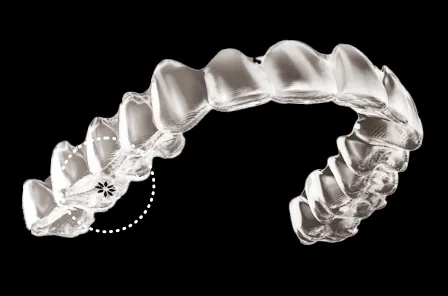
Aligners can be designed to move front teeth and level the bite. Results depend on the case.
Attachments
Tooth-coloured attachments give aligners more grip for certain movements.
Braces
Fixed braces can offer stronger control when a deep bite is pronounced.
Limits to Know About
Aligners are good at some movements and less good at others. A deep bite that comes from the jaw rather than the teeth is harder to change with aligners alone.
Your dentist will say if your case is likely to need braces or a combined plan, and we do not promise a result. Wearing the aligners as directed is a large part of how treatment goes.
It is also worth knowing that bite correction can interact with other things, such as gum health, existing fillings or crowns, and jaw comfort. These are checked at the start.
- Mild to moderate dental deep bites are more suited to aligners.
- Skeletal deep bites may need another approach.
- Gum health is checked before treatment.
- Wear time matters, because trays only work when worn.
- Existing dental work is reviewed in the plan.
What to Expect at Your Visits
The sequence below is typical. Your dentist tells you how many visits to plan for, and we do not state a fixed number.
Examination
Your dentist checks your bite, teeth and gums.
Plan
You are shown the planned movement and the price range.
Treatment
Aligners are worn as directed, with attachments if needed.
Check-ups
Progress is checked and adjustments are made if necessary.
Retention
Retainers help the bite stay in its new position.
What It Costs
The published figures are ranges. Your dentist confirms the price that applies to your plan after examination.
A deep bite plan may use aligners, braces or a combination, so ask which row of the table is closest to your case.
| Option | Published price (KRW) |
|---|---|
| Invisalign | ₩2.5M to ₩7M |
| Metal braces | ₩2.8M |
| Combination braces (ceramic upper / metal lower) | ₩3.1M |
| Ceramic braces | ₩3.2M |
| Clippy-C self-ligating braces | ₩3.6M |
| Fixed retainer | ₩100,000 to ₩200,000 |
| Removable retainer | ₩150,000 to ₩200,000 |
Prices are the published non-covered price list in Korean won. VAT may apply, and your final figure is confirmed at consultation.
Retainers After Treatment
A corrected deep bite can relapse if retainers are not worn. Your dentist will explain the type of retainer and how long to wear it.
Fixed retainers are listed at ₩100,000 to ₩200,000 and removable retainers at ₩150,000 to ₩200,000. Ask about them when you agree the plan, so there are no surprises later.
Keep a spare case, follow the cleaning advice and bring the retainer to check-ups so your dentist can see how well it fits.
Questions to Ask at Your Consultation
These questions help you understand whether aligners are realistic for your bite.
- Is my deep bite dental, or does it involve the jaw?
- Are aligners enough, or would braces be more suitable?
- Will I need attachments, and how do they look?
- What is the price range for my plan?
- What retainer will I need afterwards?
English-speaking dentists in Seongnam
The clinic was founded by two brothers trained at Seoul National University who direct it together. Three further dentists hold Ministry of Health and Welfare specialist certifications. Full credentials →

Dr. Hyeonjoon Park
Clinic Director
- Co-founder and joint clinic director
- DDS, Seoul National University School of Dentistry
- Master’s degree, SNU Graduate School of Dentistry
- Former staff, Dept. of General Dentistry, SNU Dental Hospital
- Affiliate Associate Fellow, American Academy of Implant Dentistry (AAID)
- Certified Invisalign Provider; leads orthodontic treatment
- Course completion, UCLA, USA
- Member, UPenn Endodontics Study Club, USA
- Member, International Congress of Oral Implantologists (ICOI)
- Member, Seoul Prime Orthodontic Study Club

Dr. Hyun Sung Park
Clinic Director
- Co-founder and joint clinic director
- DDS, Seoul National University School of Dentistry
- Master’s degree, SNU Graduate School of Dentistry
- Former staff, Dept. of General Dentistry, SNU Dental Hospital
- Microendodontics Programme, SNU
- Course completion, UCLA, USA
- Member, UPenn Endodontics Study Club, USA
- Certified Invisalign Provider
- Osstem Implant AIC Programme
- Member, International Congress of Oral Implantologists (ICOI)

Dr. Yu Jin Kim
Dentist
- Board-certified specialist, Advanced General Dentistry (Ministry of Health and Welfare)
- Johns Hopkins University, USA
- Master’s degree, SNU Graduate School of Dentistry
- Former staff, Osaka University Dental Hospital, Japan

Dr. Min Ji Choi
Dentist
- Board-certified specialist, Conservative Dentistry
- Board-certified specialist, Advanced General Dentistry
- Internship and residency, Jeonbuk National University Dental Hospital
- Master’s degree in Conservative Dentistry, Jeonbuk National University

Dr. Jin Young Choi
Dentist
- Board-certified specialist, Advanced General Dentistry
- Clinical training, Faculty of Dentistry, University of British Columbia, Canada
- Master’s degree, Kyungpook National University Graduate School of Dentistry
- BA in English Language and Literature, Korea University
Deep Bite Correction: frequently asked questions
Can Invisalign fix a deep bite?
It can help in many dental cases, often with attachments. Severe or skeletal cases may need braces.
Is a deep bite bad for my teeth?
It can wear the front teeth in some people. An examination shows whether you need treatment.
What are attachments?
Small tooth-coloured shapes bonded to teeth to help aligners guide movement.
How much does it cost?
Invisalign is ₩2.5M to ₩7M and fixed braces ₩2.8M to ₩3.6M on the published list, depending on the type.
Will the bite stay corrected?
Retainers help hold the result. Skipping them can allow the bite to relapse.
Do I need braces instead of aligners?
Possibly, if the deep bite is pronounced or involves the jaw. Your dentist advises after examination.
Can adults be treated?
Yes, provided teeth and gums are healthy enough. Gum health is checked first.
Is English-language consultation available?
Yes. The clinic states that English-language consultation is available.
Ask whether aligners suit your case
Tell us what bothers you about your teeth and we will explain the options in English.
Visit us: Taepyeong Station Exit 5, Seongnam
2–3F, 1225 Seongnam-daero, Sujeong-gu, Seongnam-si, Gyeonggi-do (Taepyeong Station Exit 5)
| Monday – Wednesday | 09:30 – 20:30 |
|---|---|
| Thursday | 09:30 – 19:00 |
| Friday | 09:30 – 18:30 |
| Saturday | 09:30 – 13:00 |
| Sunday | Closed |
| Public holidays | Open |
| Lunch break | None — continuous hours |
Parking garage in the building; parking benefits for patients receiving treatment.