Custom Night Guard for Teeth Grinding near Taepyeong Station, Seongnam
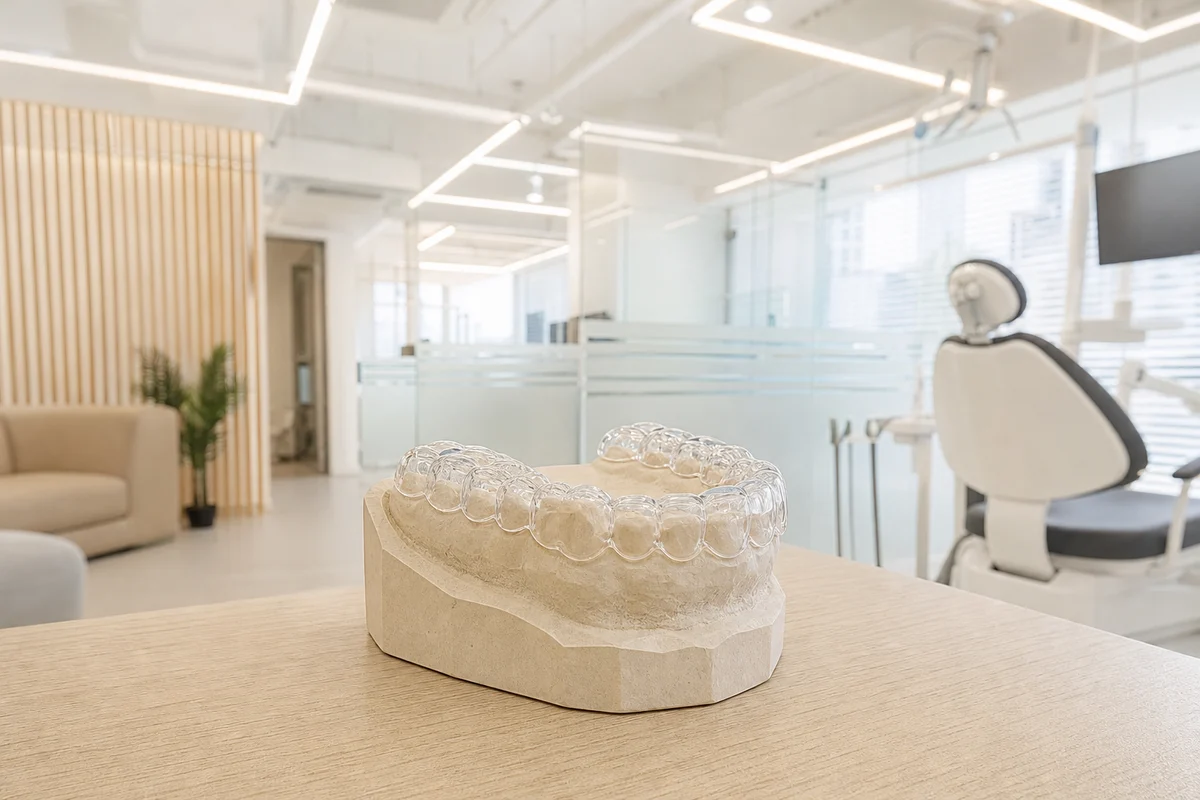
A night guard is a fitted plastic cover worn over your teeth in bed to reduce wear from grinding or clenching.
Ask about Night Guard
Tap what fits — your message is prepared for you. Nothing is sent until you press send.
Send opens your email app addressed to theseouldc@naver.com. Prefer chat? KakaoTalk channel · Instagram DM · or call +82-31-757-1525.
Message copied. Please call +82-31-757-1525 or email theseouldc@naver.com.
A night guard is a fitted plastic cover worn over your teeth in bed to reduce wear from grinding or clenching. A custom guard is made from an impression or scan of your own teeth, which is different from a ready-made pharmacy guard. The price is not published and is quoted after examination, and a related TMJ splint is published at ₩600,000.
Why People Need a Night Guard
Many people grind or clench their teeth in their sleep without knowing. The first clues are often indirect: a partner hears grinding, you wake with a tight jaw, or your dentist notices flat, worn or chipped teeth.
Grinding and clenching put strong force on teeth, gums and the jaw joint. Over time that can wear enamel, crack teeth or fillings, make teeth sensitive and strain the muscles. A night guard does not stop the habit, but it places a cushion between the teeth so they do not wear against each other.
Stress, poor sleep, some medicines and bite patterns are often linked with grinding. Your dentist can look for signs of wear and ask about your sleep and habits.
Not every morning ache is grinding, and not every grinder needs a guard. An examination decides what is appropriate.
- Waking with a tight or sore jaw
- Headaches around the temples in the morning
- Flattened, chipped or worn teeth
- Sensitive teeth without obvious decay
- A partner who hears grinding at night
Custom Guard or Pharmacy Guard
A pharmacy guard can be a reasonable stopgap if you are waiting for an appointment. It is less likely to match your bite, and a poorly shaped one can feel awkward or move in the night.
A custom guard costs more, but it is shaped to your teeth and checked by your dentist. It can be adjusted if your bite feels off.
If you are unsure, bring the guard you have been using to the examination. Your dentist can see how it has worn and what it says about your habits.
| Custom guard | Ready-made or boil-and-bite | |
|---|---|---|
| Fit | Made from a mould or scan of your teeth | General shape, adjusted by you |
| Comfort | Usually thinner and more stable | Often bulkier, can shift |
| Bite check | Adjusted by your dentist | Not adjusted professionally |
| Durability | Made for long-term use, depending on your grinding | Varies with the product |
| Cost | Quoted after examination | Set by the product |
A poorly fitting guard can change how your teeth meet or strain the jaw. If a guard hurts, stop using it and tell your dentist.
Night Guards for Taepyeong, Moran, Sujin and Bundang Residents
The clinic is by Taepyeong Station, Exit 5, in Sujin-dong, Sujeong-gu, Seongnam. If you live or work in Taepyeong, Moran, Sujin, Sinheung, Gachon or the Wirye New Town area, the fitting and check visits for a guard can happen near home.
A custom guard usually takes two visits: one to take the record and one to fit and adjust. A short follow-up is often useful. Having the clinic close by keeps these visits manageable.
Moran and Sujin are on the Line 8 side of the local map, and Moran and Bokjeong also appear on the Suin-Bundang Line, so many Bundang-side residents can plan a route by subway. We do not quote travel times; check your own route in a map app before booking.
English consultation is available. The clinic is open Mon–Wed 09:30–20:30, Thu 09:30–19:00, Fri 09:30–18:30 and Sat 09:30–13:00, with no lunch break; it is closed on Sundays and open on public holidays.
How a Custom Guard Is Made
The process is simple, but each stage matters for comfort. Your dentist explains what applies to you and answers questions in English.
The number of visits and the timeline depend on your case, and the clinic confirms them when you book.
Examination
Your dentist checks your teeth, gums, jaw muscles and joint, and looks for signs of wear.
Record of your teeth
An impression or scan of your teeth is taken so the guard matches your bite.
Fitting
The finished guard is tried in, checked for how your teeth meet and adjusted.
Follow-up
You return if it feels uncomfortable or loose, and for periodic checks of wear.
Caring for Your Guard
A guard lasts better and stays hygienic if you look after it. Rinse it each morning and brush it gently with a soft toothbrush and mild soap, not toothpaste, which can scratch the surface.
Keep it in a ventilated case when not in use, away from heat. Hot water, direct sun and car dashboards can warp plastic. Keep it away from pets, who find guards tempting.
Check regularly for cracks, rough edges or thin spots. A worn-through guard no longer protects, so bring it to a check-up.
Your teeth and gums also need regular care. Keep up brushing, flossing and cleaning visits, as a guard does not replace them.
- Rinse and brush it daily
- Store it dry in its case
- Never use hot water
- Bring it to dental check-ups
When a Guard Is Not Enough
A night guard protects teeth, but it may not solve every jaw problem. If you have jaw pain, clicking, locking or limited opening, your dentist may suggest an assessment for a temporomandibular disorder.
In that case a TMJ splint, published at ₩600,000, might be more suitable than a basic night guard. Other options, such as jaw botox (₩90,000 or ₩150,000), are sometimes discussed for strong clenching. Which of these fits depends on examination.
Bite problems, missing teeth or worn restorations may need separate treatment. Grinding that continues despite a guard, or a guard that causes pain, should be reviewed by your dentist.
If you suspect a sleep disorder such as sleep apnea, tell your dentist or doctor. This is outside what a guard can manage.
Questions to Ask at Your Appointment
A short list helps you leave with a clear understanding. Ask in English; the clinic offers English-language consultation.
If the price, the number of visits or the material is unclear, ask for it in writing.
- Is a night guard or a TMJ splint better for me?
- How much will the guard cost, and what does it include?
- How many visits are needed?
- How often should the guard be checked?
- What should I do if it feels wrong?
English-speaking dentists in Seongnam
The clinic was founded by two brothers trained at Seoul National University who direct it together. Three further dentists hold Ministry of Health and Welfare specialist certifications. Full credentials →

Dr. Hyun Sung Park
Clinic Director
- Co-founder and joint clinic director
- DDS, Seoul National University School of Dentistry
- Master’s degree, SNU Graduate School of Dentistry
- Former staff, Dept. of General Dentistry, SNU Dental Hospital
- Microendodontics Programme, SNU
- Course completion, UCLA, USA
- Member, UPenn Endodontics Study Club, USA
- Certified Invisalign Provider
- Osstem Implant AIC Programme
- Member, International Congress of Oral Implantologists (ICOI)

Dr. Yu Jin Kim
Dentist
- Board-certified specialist, Advanced General Dentistry (Ministry of Health and Welfare)
- Johns Hopkins University, USA
- Master’s degree, SNU Graduate School of Dentistry
- Former staff, Osaka University Dental Hospital, Japan

Dr. Min Ji Choi
Dentist
- Board-certified specialist, Conservative Dentistry
- Board-certified specialist, Advanced General Dentistry
- Internship and residency, Jeonbuk National University Dental Hospital
- Master’s degree in Conservative Dentistry, Jeonbuk National University

Dr. Jin Young Choi
Dentist
- Board-certified specialist, Advanced General Dentistry
- Clinical training, Faculty of Dentistry, University of British Columbia, Canada
- Master’s degree, Kyungpook National University Graduate School of Dentistry
- BA in English Language and Literature, Korea University

Dr. Hyeonjoon Park
Clinic Director
- Co-founder and joint clinic director
- DDS, Seoul National University School of Dentistry
- Master’s degree, SNU Graduate School of Dentistry
- Former staff, Dept. of General Dentistry, SNU Dental Hospital
- Affiliate Associate Fellow, American Academy of Implant Dentistry (AAID)
- Certified Invisalign Provider; leads orthodontic treatment
- Course completion, UCLA, USA
- Member, UPenn Endodontics Study Club, USA
- Member, International Congress of Oral Implantologists (ICOI)
- Member, Seoul Prime Orthodontic Study Club
Night Guard: frequently asked questions
How much does a custom night guard cost?
The price is not published and is quoted after examination. A TMJ splint is published separately at ₩600,000.
Is a custom guard better than a pharmacy guard?
A custom guard is made for your teeth and checked by your dentist, while a ready-made one is a general shape. Which suits you depends on your symptoms and budget.
Will a night guard stop me grinding?
No. It protects your teeth from wear, but it does not necessarily stop the habit. Your dentist can discuss other approaches.
How do I know if I grind my teeth?
Clues include morning jaw tightness, headaches, worn teeth and a partner hearing grinding. A dentist can examine for wear.
How long does a guard last?
It depends on how hard you grind and how you care for it. Bring it to check-ups so your dentist can see how it has worn.
What is the difference between a night guard and a TMJ splint?
A night guard mainly protects teeth, while a TMJ splint is used when jaw joint or muscle symptoms are present. Your dentist decides which is appropriate.
Can I wear a guard if I have braces or implants?
Possibly, but it needs to be designed with them in mind. Tell your dentist about any orthodontic or implant work.
How many visits do I need?
A record visit and a fitting visit are typical, with follow-up if needed. Your dentist confirms for your case.
Can I book in English?
Yes. English-language consultation is available.
Ask About a Night Guard
Call +82-31-757-1525 or send a message about your symptoms. We will examine your teeth and explain options in English.
Visit us: Taepyeong Station Exit 5, Seongnam
2–3F, 1225 Seongnam-daero, Sujeong-gu, Seongnam-si, Gyeonggi-do (Taepyeong Station Exit 5)
| Monday – Wednesday | 09:30 – 20:30 |
|---|---|
| Thursday | 09:30 – 19:00 |
| Friday | 09:30 – 18:30 |
| Saturday | 09:30 – 13:00 |
| Sunday | Closed |
| Public holidays | Open |
| Lunch break | None — continuous hours |
Parking garage in the building; parking benefits for patients receiving treatment.