
Wisdom Tooth Pain: Signs It Needs to Come Out
Published by The Seoul Dental Clinic · Meet the dentists

A wisdom tooth should come out when it causes repeated infection, damages the tooth next to it, decays beyond repair or sits in a position that cannot be cleaned. A wisdom tooth that is healthy, fully erupted and easy to clean can often stay. Only an examination and an X-ray can tell which group you are in.
Signs a wisdom tooth is a problem
Wisdom teeth are the last molars and often have too little room. Some come in sideways or only partly, leaving a flap of gum where food and bacteria collect.
See a dentist if you notice:
- Repeated soreness or swelling of the gum behind your last molar
- Pain that spreads to the ear, jaw or neck
- A bad taste or smell near the back of the mouth
- Difficulty opening the mouth fully
- Food packing around the tooth that you cannot clean
- Damage or decay on the molar in front of it
Why some wisdom teeth are removed and some are not
| Situation | Usual thinking |
|---|---|
| Recurring infection around a partly erupted tooth | Removal is commonly advised |
| Decay that cannot be restored | Removal is often advised |
| Pushing on or damaging the neighboring tooth | Removal is commonly advised |
| Fully erupted, healthy, cleanable, no symptoms | Often monitored |
| Impacted but symptom-free | Decided case by case after imaging |
Decisions depend on your age, X-ray findings and health, and are discussed with you.
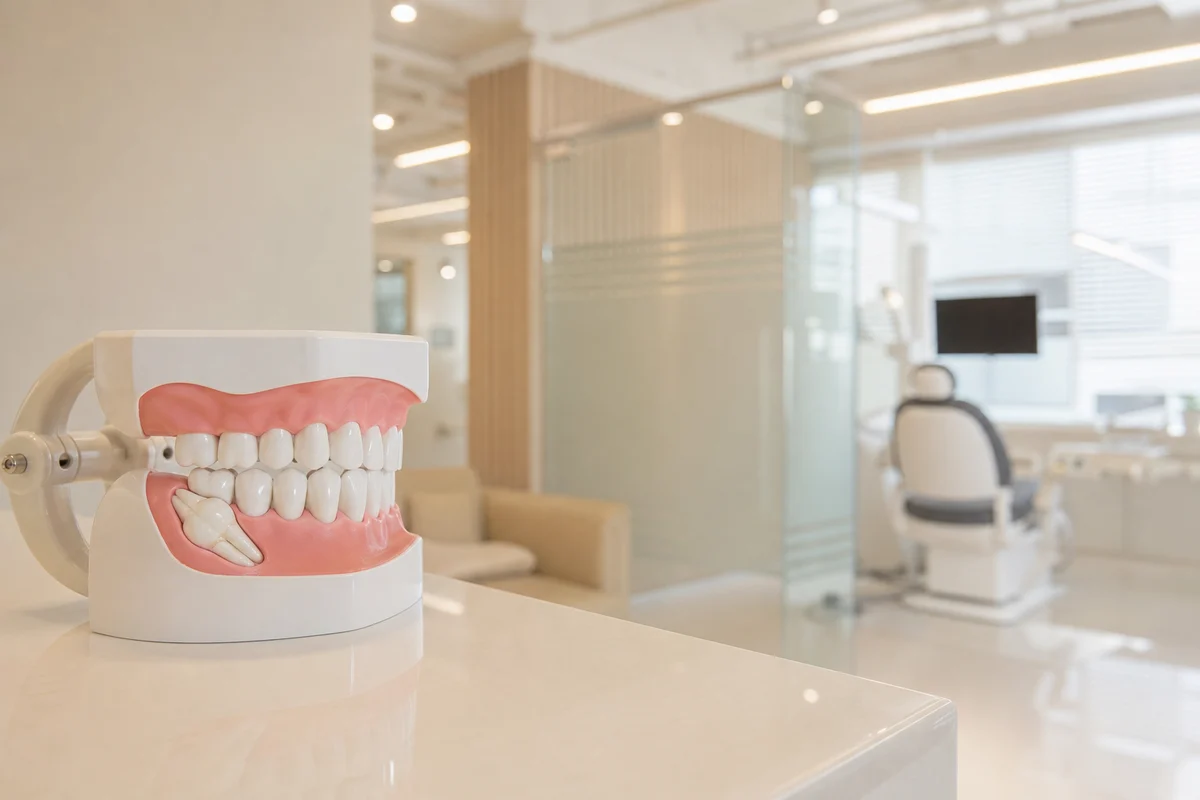
How the dentist decides
Examine
The dentist checks the gum, the tooth and neighboring teeth, and asks about your history of pain and swelling.
X-ray or scan
Imaging shows the tooth position and its relationship to nerves and sinus. Imaging fees are quoted after examination.
Explain options
You hear whether to remove, monitor or treat an infection first, plus risks and likely recovery.
Plan the day
If removal is chosen, we agree timing, sedation preference and aftercare.
Cost and comfort options
No fixed price for wisdom tooth removal is published, because the work ranges from a simple extraction to a tooth that must be sectioned or lies deeper in the bone. The fee is quoted after examination.
Local anesthetic is used for the procedure itself. If you are anxious, conscious sedation is available at published prices of ₩300,000 (general) and ₩400,000 (with an anesthesiologist). Whether sedation suits you is decided after a health check. VAT may apply.
After removal and when to call
Expect some swelling, tenderness and limited opening for a few days, easing gradually. Follow the instructions you are given on rest, cold packs, eating soft food and keeping the area clean without disturbing the clot.
Call the clinic if pain gets worse after it had been settling, if bleeding does not stop with firm pressure, or if you develop fever or spreading swelling. Plan travel after the procedure with your dentist rather than assuming you can fly the next day.
Questions worth asking before removal
Ask which of your wisdom teeth are involved, how the dentist rates the difficulty, and what the risks are for your case, including how close the tooth sits to nerves. Ask what you can expect afterwards and what to do if something feels wrong.
Also ask whether the teeth can be removed in one visit or in stages, what is included in the quoted fee, and what you should arrange beforehand, such as time off work or someone to accompany you if you choose sedation.
Seeing us in Seongnam
Our English-language consultation is at The Seoul Dental Clinic by Taepyeong Station Exit 5, Sujin-dong, Sujeong-gu. Residents around Moran, Sinheung and Gachon can use Line 8 or the Suin-Bundang Line to reach us.
Frequently asked questions
Do all wisdom teeth need to be removed?
No. Healthy, fully erupted, cleanable ones can often stay. Problem teeth are commonly removed.
How much does removal cost?
No fixed fee is published. It depends on difficulty and is quoted after examination.
Can I have it done under sedation?
Conscious sedation is available at ₩300,000 (general) or ₩400,000 (with an anesthesiologist), if suitable for you.
How long is recovery?
It varies with difficulty. Most swelling and soreness settle gradually over several days, and your dentist will explain what to expect.
Can I fly after removal?
Ask your dentist before booking flights. It depends on how the procedure went and how you are healing.
English-speaking dentists in Seongnam
The clinic was founded by two brothers trained at Seoul National University who direct it together. Three further dentists hold Ministry of Health and Welfare specialist certifications. Full credentials →

Dr. Hyun Sung Park
Clinic Director
- Co-founder and joint clinic director
- DDS, Seoul National University School of Dentistry
- Master’s degree, SNU Graduate School of Dentistry
- Former staff, Dept. of General Dentistry, SNU Dental Hospital
- Microendodontics Programme, SNU
- Course completion, UCLA, USA
- Member, UPenn Endodontics Study Club, USA
- Certified Invisalign Provider
- Osstem Implant AIC Programme
- Member, International Congress of Oral Implantologists (ICOI)

Dr. Hyeonjoon Park
Clinic Director
- Co-founder and joint clinic director
- DDS, Seoul National University School of Dentistry
- Master’s degree, SNU Graduate School of Dentistry
- Former staff, Dept. of General Dentistry, SNU Dental Hospital
- Affiliate Associate Fellow, American Academy of Implant Dentistry (AAID)
- Certified Invisalign Provider; leads orthodontic treatment
- Course completion, UCLA, USA
- Member, UPenn Endodontics Study Club, USA
- Member, International Congress of Oral Implantologists (ICOI)
- Member, Seoul Prime Orthodontic Study Club
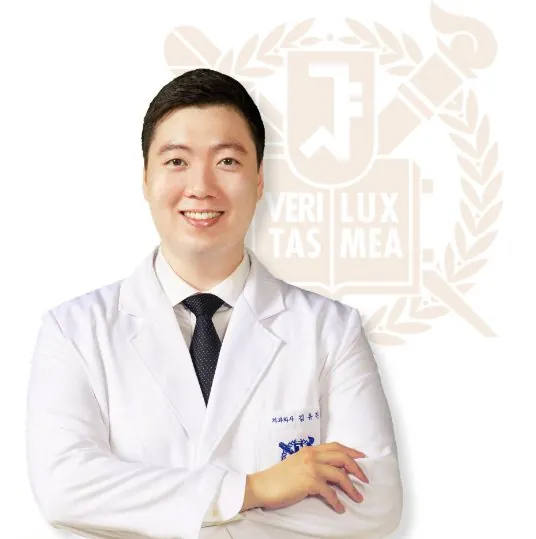
Dr. Yu Jin Kim
Dentist
- Board-certified specialist, Advanced General Dentistry (Ministry of Health and Welfare)
- Johns Hopkins University, USA
- Master’s degree, SNU Graduate School of Dentistry
- Former staff, Osaka University Dental Hospital, Japan

Dr. Min Ji Choi
Dentist
- Board-certified specialist, Conservative Dentistry
- Board-certified specialist, Advanced General Dentistry
- Internship and residency, Jeonbuk National University Dental Hospital
- Master’s degree in Conservative Dentistry, Jeonbuk National University

Dr. Jin Young Choi
Dentist
- Board-certified specialist, Advanced General Dentistry
- Clinical training, Faculty of Dentistry, University of British Columbia, Canada
- Master’s degree, Kyungpook National University Graduate School of Dentistry
- BA in English Language and Literature, Korea University
Get a clear answer
Book an English consultation near Taepyeong Station. We will examine, image if needed, and explain whether the tooth should go or stay.