
Immediate or Delayed Implant Placement After an Extraction?
Published by The Seoul Dental Clinic · Meet the dentists
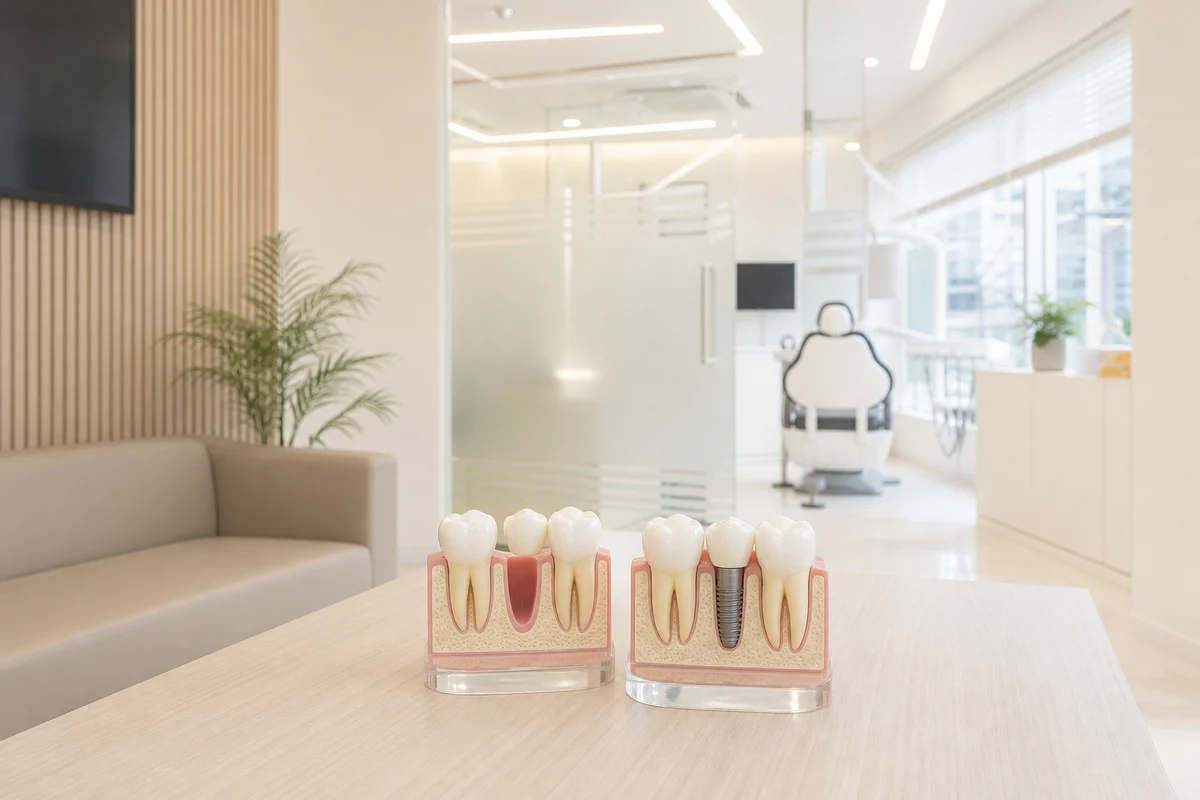
Immediate placement means the implant goes into the socket on the same day the tooth is removed. Delayed placement means the socket heals first, usually for a few months, before the implant is placed. Neither is better in every case: infection, the amount of bone left and the position of the tooth decide which is suitable, and your dentist confirms this after examination and imaging.
Two ways to time an implant
When a tooth cannot be saved, the question of what replaces it often comes up before the tooth is even removed. For an implant, the main timing choice is whether to place it at the same visit as the extraction or to let the area heal first.
With immediate placement, the dentist removes the tooth carefully and places the implant into the fresh socket in the same session. Any gaps between the implant and the socket walls may be filled with graft material. The implant then heals in the bone for a period before the final crown is made.
With delayed placement, the tooth is removed and the socket is left to heal. Sometimes graft material is placed in the socket at extraction to help keep the shape of the ridge. Once the bone has healed, usually after a few months depending on the site, the implant is placed in a separate procedure.
There is also a middle route, often called early placement, where the implant is placed a few weeks after extraction once the gum has closed but before the bone has fully remodelled. Your dentist may mention it if your case sits between the two.
Side by side
This is a general comparison. The right choice depends on your examination and imaging.
| Immediate placement | Delayed placement | |
|---|---|---|
| When the implant goes in | Same visit as the extraction | After the socket has healed |
| Number of surgical visits | Usually one for extraction and implant | Usually two, extraction then implant |
| Overall treatment time | Can be shorter | Longer, because of the healing wait |
| Infection at the site | Needs careful assessment; may rule it out | Time for infection to settle first |
| Bone grafting | Often used to fill gaps around the implant | May be placed at extraction or at implant surgery |
| Suitability | Depends closely on the site | Possible in most cases where an implant is suitable |
Bone graft is listed at ₩100,000, ₩200,000, ₩400,000, ₩600,000 or ₩1,000,000 depending on extent. Your written quote shows which items apply.
What decides the choice
The reason the tooth is being removed is the first clue. A tooth lost to a recent fracture or injury, without long-standing infection, is more often considered for immediate placement. A tooth that has been loose for years from gum disease, or one with a large infection at the root, is more often treated in stages so the area can heal first.
The amount and shape of the remaining bone is the second. The implant needs to be held firmly from the start, which depends on bone around and beyond the socket. In the front of the upper jaw, the outer bone wall is often thin, and its condition affects how the gum line looks later. In the upper back jaw, the sinus may limit the height of bone available.
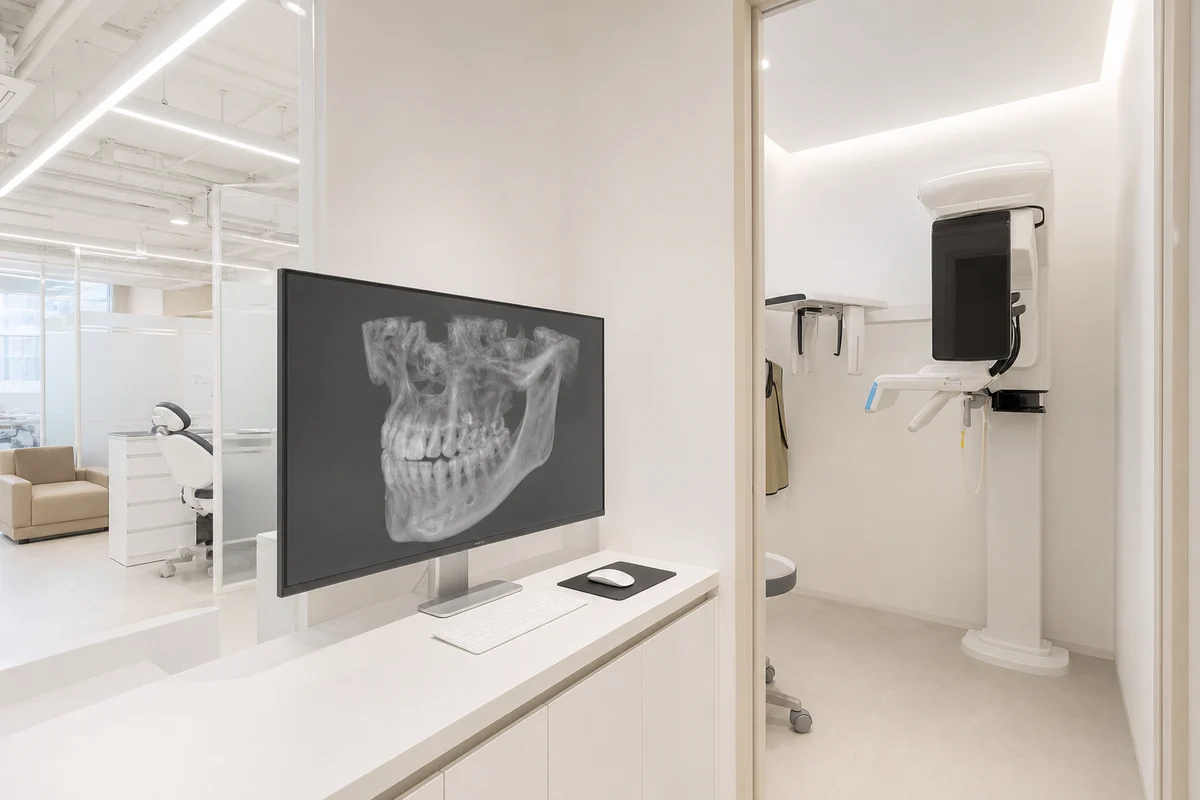
Your general health, smoking and gum condition also count. A 3D scan helps the dentist see the bone in detail and plan the implant position. At The Seoul Dental Clinic, guided or navigation placement can be planned where the case calls for it; it is not a separate line on the published list. The scan fee is not published and is quoted after examination.
- Why the tooth is being removed
- Infection at the root or in the gum
- How much bone remains, and its shape
- Whether the tooth is in the visible smile zone
- General health, smoking and gum condition
Immediate placement is not the same as an immediate tooth
A common misunderstanding is that immediate placement means leaving with a finished tooth the same day. Usually it does not. The implant is placed immediately, but the final crown comes later, after the bone has bonded to it.
In the meantime you may have a temporary tooth. Depending on how firmly the implant is held, this might be a temporary crown on the implant or a removable temporary tooth. For front teeth, your dentist will discuss how to avoid a visible gap while you heal. For several missing teeth, temporary teeth fixed to implants are part of some full-arch plans, which have their own page.
Ask your dentist exactly what you will have in your mouth on each stage of the plan, and what you can eat with it.
How an immediate placement visit usually runs
If immediate placement is chosen, the order is typically as follows. If the dentist finds during extraction that the site is not suitable after all, the plan may switch to a staged approach.
Assessment beforehand
The cause of extraction, any infection and the bone are checked with examination and imaging, and the plan is explained to you.
Gentle extraction
The tooth is removed while protecting the surrounding bone as much as possible, and any infected tissue is cleaned out.
Implant and graft
The implant is placed in the socket. Graft material is added where needed to support the bone around it.
Temporary stage
A temporary solution is fitted if planned, and you receive aftercare instructions for the healing period.
Final crown
Once healing is confirmed, the abutment and final crown are fitted and your bite is checked.
Costs and recovery
The timing method does not have its own fee on the published list. The cost is made up of the same items as any implant: the implant itself, an abutment if needed, the crown and any bone graft. For example, an Osstem standard implant is listed at ₩650,000, and a zirconia implant crown at ₩450,000 per tooth. Extraction prices are not published and are quoted after examination.
Recovery after an immediate placement is similar to an extraction combined with implant surgery. Some swelling and discomfort for a few days is common, and you will be asked to eat soft food and avoid chewing on the area. If swelling grows after the first days, pain worsens, or you develop a fever, contact the clinic rather than waiting.
If you live abroad or travel often, tell your dentist early. Immediate placement can sometimes reduce the number of surgical visits, but healing time before the final crown still applies.
Video: our dentists explain
In Korean. On YouTube, turn on subtitles and choose Settings → Subtitles → Auto-translate → English.
What this video covers
The dentists explain that placing an implant on the day a tooth is extracted (immediate placement) can shorten treatment when conditions allow, but it depends on how much bone remains, the gum condition, and whether infection can be fully removed; the plan may change once the tooth is out. Otherwise implants may be placed after one to two months, after three to four months, or later if infection is severe, so there is no fixed waiting period. They stress that a same-day implant does not mean chewing on it the same day: even when a temporary front tooth is fitted, it is not for normal biting, and patients should ask whether a temporary tooth is included and when chewing can start. They also explain why front-tooth implants often involve bone grafting, why bone does not simply regrow if you wait (socket preservation can help), and why healing time after placement varies with initial stability and bone quality.
- Immediate placement depends on remaining bone, gum condition and infection, not speed alone
- Same-day implant does not mean same-day chewing; temporary teeth need careful use
- Bone shrinks after extraction rather than refilling, so grafting or socket preservation may be advised
Frequently asked questions
Can anyone have an implant placed the same day as an extraction?
No. It is mainly considered when there is little or no infection and enough bone to hold the implant firmly. Your dentist decides after examination and imaging.
Is immediate placement better than waiting?
Not in every case. It can shorten treatment, but a staged approach is often the more predictable choice when infection or bone loss is present.
My tooth is infected. Can I still have an immediate implant?
It depends on how severe and long-standing the infection is. Mild cases are sometimes treated at the same visit; more serious ones usually heal first.
Will I need a bone graft?
Often some graft material is used in either approach. The amount depends on your bone and is listed by extent from ₩100,000 to ₩1,000,000.
Do I leave with a tooth the same day?
Sometimes a temporary tooth is possible, but the final crown is made after healing. Ask what you will have at each stage.
English-speaking dentists in Seongnam
The clinic was founded by two brothers trained at Seoul National University who direct it together. Three further dentists hold Ministry of Health and Welfare specialist certifications. Full credentials →

Dr. Hyun Sung Park
Clinic Director
- Co-founder and joint clinic director
- DDS, Seoul National University School of Dentistry
- Master’s degree, SNU Graduate School of Dentistry
- Former staff, Dept. of General Dentistry, SNU Dental Hospital
- Microendodontics Programme, SNU
- Course completion, UCLA, USA
- Member, UPenn Endodontics Study Club, USA
- Certified Invisalign Provider
- Osstem Implant AIC Programme
- Member, International Congress of Oral Implantologists (ICOI)

Dr. Hyeonjoon Park
Clinic Director
- Co-founder and joint clinic director
- DDS, Seoul National University School of Dentistry
- Master’s degree, SNU Graduate School of Dentistry
- Former staff, Dept. of General Dentistry, SNU Dental Hospital
- Affiliate Associate Fellow, American Academy of Implant Dentistry (AAID)
- Certified Invisalign Provider; leads orthodontic treatment
- Course completion, UCLA, USA
- Member, UPenn Endodontics Study Club, USA
- Member, International Congress of Oral Implantologists (ICOI)
- Member, Seoul Prime Orthodontic Study Club

Dr. Yu Jin Kim
Dentist
- Board-certified specialist, Advanced General Dentistry (Ministry of Health and Welfare)
- Johns Hopkins University, USA
- Master’s degree, SNU Graduate School of Dentistry
- Former staff, Osaka University Dental Hospital, Japan

Dr. Min Ji Choi
Dentist
- Board-certified specialist, Conservative Dentistry
- Board-certified specialist, Advanced General Dentistry
- Internship and residency, Jeonbuk National University Dental Hospital
- Master’s degree in Conservative Dentistry, Jeonbuk National University

Dr. Jin Young Choi
Dentist
- Board-certified specialist, Advanced General Dentistry
- Clinical training, Faculty of Dentistry, University of British Columbia, Canada
- Master’s degree, Kyungpook National University Graduate School of Dentistry
- BA in English Language and Literature, Korea University
Facing an extraction?
Book a consultation in Taepyeong, Seongnam, to find out whether immediate or staged placement suits your tooth.